
Over 60?
You May Be Able to Reposition Your 401(k) Now — and Your ORP Account at Retirement
You have spent years building your retirement savings.
As retirement gets closer, the question often changes from:
“How much have I accumulated?”
to:
“What can these accounts realistically provide as retirement income?”
If you are over age 60, you may have options available for your workplace 401(k), even if you are still employed.
Your Optional Retirement Program account may also become available to reposition once you retire or separate from employment.
The goal is not simply to move an account.
The goal is to determine whether a different strategy could help you create more predictable retirement income, reduce exposure to market losses, and protect the lifestyle you have worked so hard to build.
No cost. No obligation. Just information.
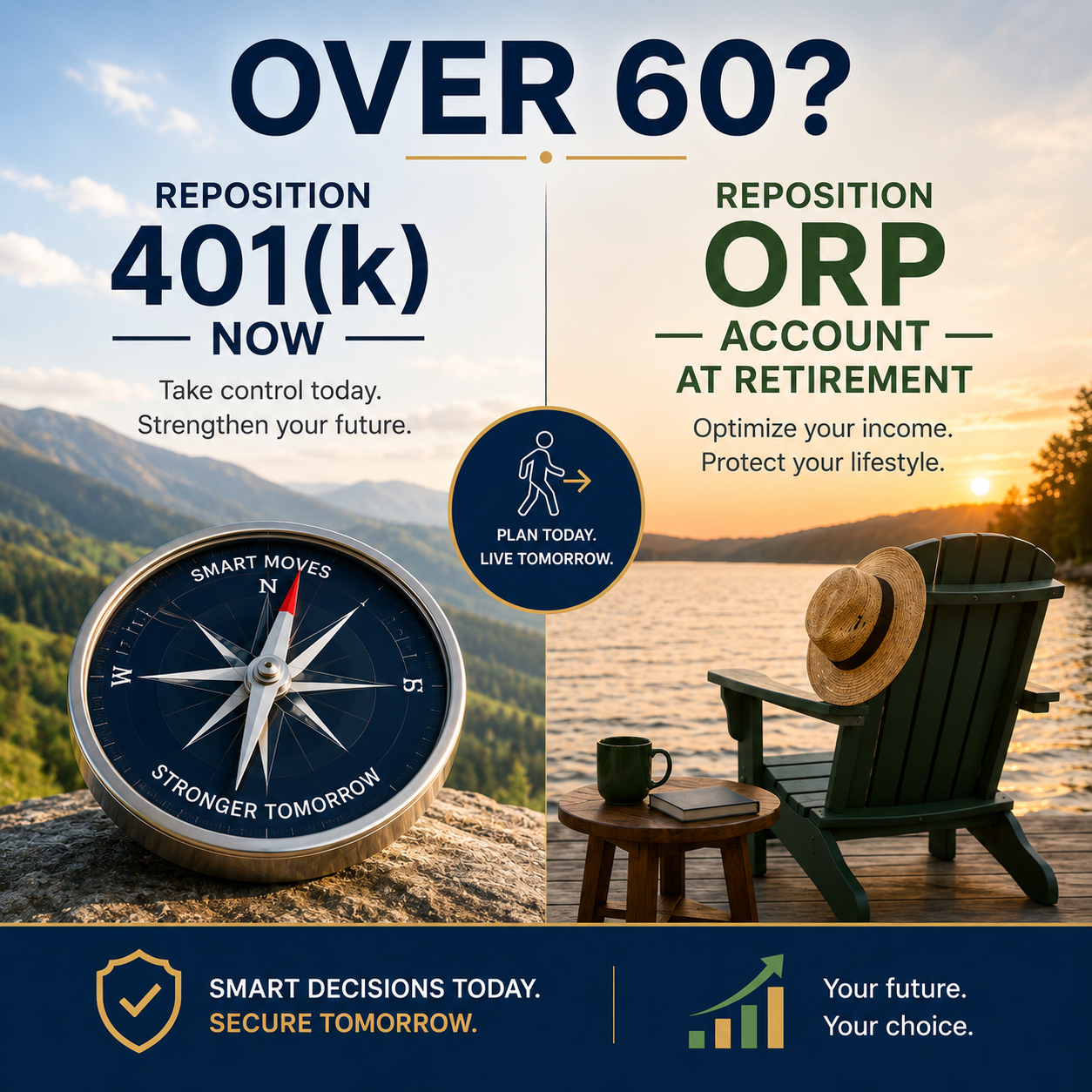

Your Retirement. Your Options. Your Choice.
Many university employees spend decades contributing to retirement plans through providers such as TIAA, Corebridge, Voya, Fidelity, Empower, and others.
These accounts may have helped you accumulate retirement assets, but the strategy that worked during your career may not be the same strategy you want during retirement.
Before making a decision, it can be helpful to understand:
What your current accounts may realistically provide as retirement income
Whether you can reposition any portion of your 401(k) while still employed
What options may become available for your ORP account at retirement
How market fluctuations could affect your retirement income plan
Whether principal protection or guaranteed income options may be appropriate
What access you would retain to your money
What you may be giving up in exchange for additional protection
How your current plan compares with other available strategies
In many cases, the current plan remains the best fit.
The objective is simply to provide additional information so you can make a more informed decision.

What Does “Reposition” Mean?
What Does “Reposition” Mean?
Repositioning does not necessarily mean moving your entire retirement account.
It may involve evaluating whether a portion of your retirement savings could be better positioned to accomplish a specific goal, such as:
Creating predictable retirement income
Protecting principal from market downturns
Reducing the effect of market volatility
Establishing income that cannot be outlived
Preserving other assets for growth or future needs
Building a strategy that complements Social Security or a pension
Some people choose to reposition only the amount needed to create their desired income.
Others may determine that their current investments and providers already meet their needs.
The right decision depends on your accounts, retirement timeline, income goals, risk tolerance, and need for access to funds.
Over 60 and Still Working?
You may not have to wait until retirement to evaluate every account.
Depending on your employer’s plan rules, employees age 59½ or older may be permitted to take an in-service distribution from certain workplace retirement accounts, including a 401(k), while remaining employed.
This could allow you to reposition eligible funds without retiring or leaving your position.
However, availability depends on the specific plan.
Before taking action, your plan documents should be reviewed to determine:
Whether in-service distributions are permitted
Which account balances are eligible
Whether employer contributions are included
Whether any restrictions or waiting periods apply
Whether the transfer can be completed directly without creating a taxable distribution
Your ORP account generally follows different rules and may not become available until retirement or separation from employment.
That is why it is important to evaluate each account separately.

What You Will Receive A Personalized Retirement Income Analysis?
We begin by gathering basic information about your current retirement accounts, age, retirement timeline, and income goals.
Your analysis may include:
Current account values
Estimated retirement date
Desired income start date
Individual or joint income needs
Current provider information
Available retirement income approaches
Potential income under different strategies
Access and liquidity considerations
Protection features
Important limitations and tradeoffs
The purpose is to help you understand how your retirement assets may work together.

A Side-by-Side Comparison
Your current strategy can be compared with other available approaches.
This may help you evaluate differences in:
Retirement income
Market exposure
Principal protection
Growth potential
Liquidity
Fees or rider charges
Surrender periods
Beneficiary value
Income guarantees
Long-term care or enhanced income features, when available
No strategy is best in every category.
Greater protection may involve giving up some market growth potential or
accepting restrictions on access.
A proper comparison should clearly show both the benefits and the tradeoffs.
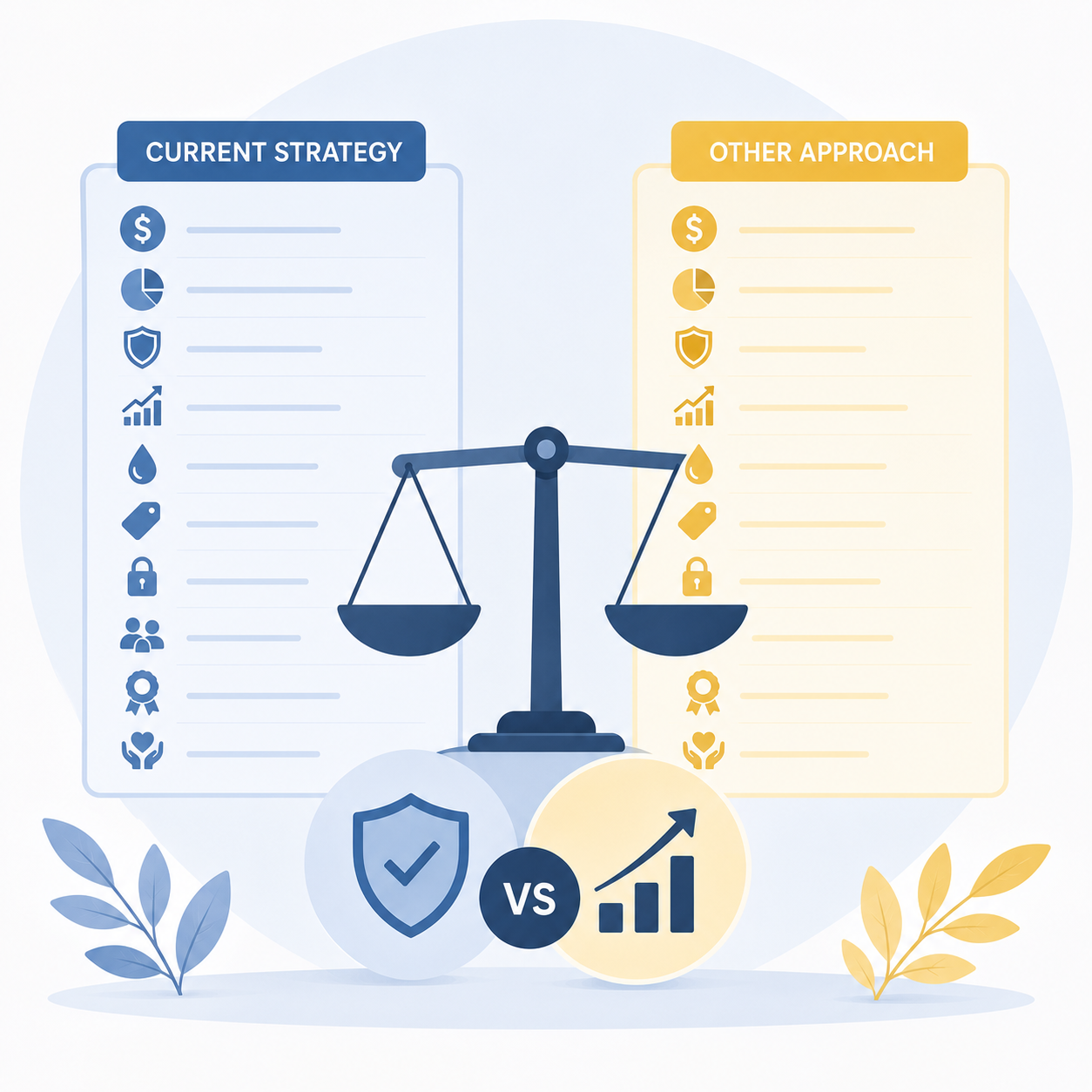


Once the analysis is complete, we review the results together.
You will have an opportunity to ask questions and understand how each option works.
There is no expectation that you make an immediate decision.
The purpose of the review is to help you understand the information, not to pressure you into making a change.
A Personal Review

Can I reposition my 401(k) while I am still employed?
When will my ORP account become available?
What could my retirement accounts provide as monthly or annual income?
How would delaying income affect the amount I could receive?
Should the income cover one life or two?
What happens if the account value declines?
Can the income continue even if the account is depleted?
How much access would I have to my money?
What happens to the remaining value when I die?
Are there fees or surrender charges?
Could I receive additional income if I need qualifying care?
Should I reposition all of the account or only a portion?
What am I giving up in exchange for additional protection?
How does the strategy compare with leaving the money where it is?
Questions the Analysis Can Help Answer
What Are You Giving Up for Protection?
Protection from market losses can be valuable, especially as retirement gets closer.
However, protection is not free of tradeoffs.
Depending on the strategy, you may give up or limit:
Direct participation in stock-market gains
Unlimited growth potential
Immediate access to all funds
Flexibility during a surrender-charge period
Certain investment choices
Some liquidity beyond the available free-withdrawal amount
This does not automatically make a protected strategy good or bad.
It means the decision should be based on what matters most to you.
For example, one portion of your retirement assets may remain invested
for long-term growth, while another portion is positioned to create predictable income.
The goal is not necessarily to choose between growth and protection.
The goal is to determine the appropriate balance.


A Simple Four-Step Process
1. Gather Information
We gather basic information about your retirement accounts, retirement timeline, and income goals.
2. Create the Analysis
I prepare a personalized retirement income analysis based on the information provided.
3. Review the Results
We review the analysis together and discuss the benefits, limitations, and tradeoffs of each option.
4. You Keep the Analysis
You keep the information for future comparison and decide whether any next step makes sense.
This review may be helpful if you:
Are age 60 or older
Work for a Tennessee college or university
Participate in an ORP, 401(k), 403(b), 457, or similar retirement plan
Have accounts with TIAA, Corebridge, Voya, Fidelity, Empower, or another provider
Are within several years of retirement
Recently retired or separated from employment
Want to understand what your accounts could provide as retirement income
Are concerned about market fluctuations
Want to compare your current plan with protected-income options
Prefer to understand your choices before making a decision
Who This is Designed For
・
Who This is Designed For ・
FAQs
Is there a cost for the analysis?
1
No. There is no cost or obligation to receive and review the retirement income analysis.
2
Can I reposition my 401(k) while I am still employed?
Possibly. Some employer plans permit in-service distributions after age 59½, while others do not. Your specific plan rules must be reviewed.
Can I reposition my ORP account before retirement?
3
ORP availability depends on the employer’s plan rules and your employment status. In many cases, ORP funds become available after retirement or separation from service.
Are protected retirement strategies invested directly in the stock market?
4
Fixed and fixed-indexed annuities are not directly invested in the stock market. Interest-crediting methods may be linked to the performance of an external market index, but funds are not invested directly in that index.
Can retirement income be guaranteed for life?
5
Certain annuity contracts offer optional or built-in income features designed to provide income for life, subject to the terms of the contract and the financial strength and claims-paying ability of the issuing insurance company.
Will I lose access to my money?
6
Some retirement income strategies include annual penalty-free withdrawal provisions, but withdrawals above the permitted amount may be subject to surrender charges during a specified period. These terms should be reviewed carefully before making a decision.
What if I already work with an advisor?
7
You can still request an analysis. The information can provide a second perspective and may be compared with recommendations you have already received.
Do I have to move the entire account?
8
No. Depending on the plan rules and strategy, you may be able to reposition only a portion of the account.
The best time to understand your retirement options is before you need to make a final decision.
A brief review today may help you enter retirement with greater clarity and confidence.
Plan Today.
Live Tomorrow.

This material is for informational purposes only and is not intended as investment, legal, accounting, or tax advice.
Insurance and annuity products are not deposits, are not insured by the FDIC or any federal government agency, are not guaranteed by a bank, and may lose value if surrendered before the end of the applicable surrender-charge period.
Guarantees are backed by the financial strength and claims-paying ability of the issuing insurance company.
Withdrawals may be subject to ordinary income taxes and, if taken before age 59½, may also be subject to an additional federal tax penalty. Consult a qualified tax professional regarding your individual circumstances.
Any references to employer retirement plans, in-service distributions, ORP availability, or rollover eligibility are subject to the specific terms of the employer’s plan.
Aaron Payne is not affiliated with or endorsed by MTSU, the State of Tennessee, TIAA, Corebridge, Voya, Fidelity, Empower, or any other retirement-plan provider mentioned on this page.