OVER 60?
You May Have More Options for Your 401(k) Than You Realize.
Still working?
Depending on your employer's retirement plan rules, you may be able to move some or all of your 401(k) without retiring or leaving your job.
This is commonly referred to as an in-service distribution.
The important question is:
What options are available to you — and would any of them improve your retirement plan?
Complimentary review. No obligation.
YOU DON'T NECESSARILY HAVE TO RETIRE TO HAVE OPTIONS
Many people assume their 401(k) has to stay exactly where it is until they retire.
That isn't always the case.
Depending on your plan's rules and your age, you may be eligible for an in-service distribution while you are still actively employed.
That could allow you to reposition eligible retirement assets while continuing to work and contribute to your employer's retirement plan.
Every employer plan is different, so eligibility should always be verified before making any decisions.
WHY WOULD SOMEONE CONSIDER REPOSITIONING A 401(k)?
As retirement gets closer, your priorities may begin to change.
During your working years, the primary objective may have been accumulation.
As you approach retirement, other questions become increasingly important:
PROTECTION
How much of your retirement savings do you want exposed to market losses immediately before or during retirement?
INCOME
How will your retirement accounts actually produce the monthly income you need?
LONGEVITY
What happens if you live 20, 25 or 30+ years after retiring?
LEGACY
How much of your retirement savings would you like to preserve for your spouse or beneficiaries?
There isn't one strategy that's right for everyone.
The goal is to understand the choices available to you before you need the money.
YOU DON'T HAVE TO MOVE EVERYTHING
Retirement planning doesn't have to be an all-or-nothing decision.
In some situations, it may make sense to leave a portion of your assets in your existing retirement plan while repositioning another portion for a specific purpose.
For example, one portion might remain invested for long-term growth while another is positioned for:
Market protection
Guaranteed lifetime income
Principal protection
Future healthcare-related income features
The appropriate strategy depends on your individual situation, goals and risk tolerance.
WHAT COULD YOUR RETIREMENT INCOME LOOK LIKE?
Accumulating money is only half of retirement planning.
Eventually, the question becomes:
How much income can my retirement savings actually produce?
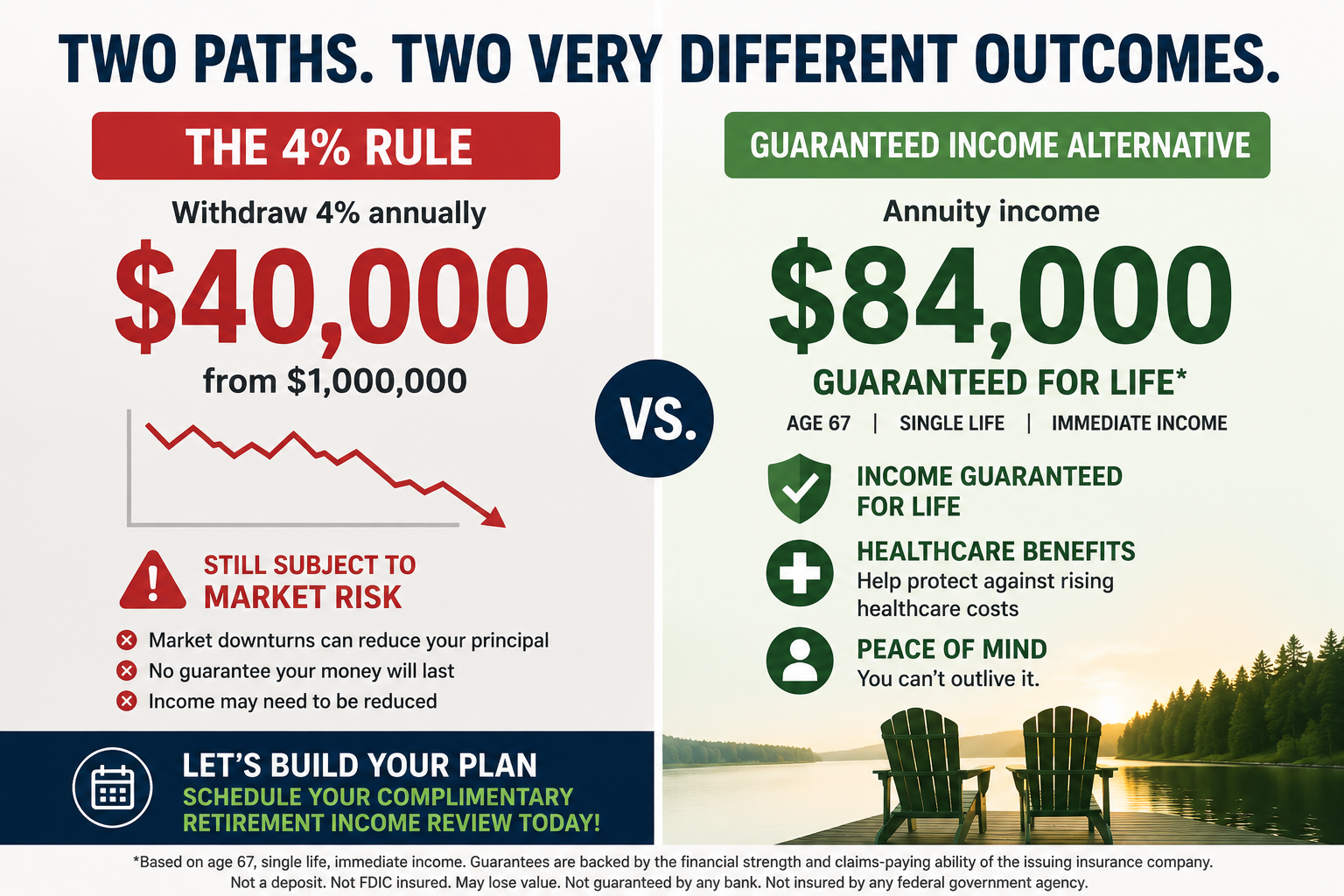
Different retirement income strategies can produce dramatically different results.
For example, consider someone with a:
$1,000,000 Retirement Account
A hypothetical 4% withdrawal strategy would begin with:
$40,000 Per Year
That money remains subject to investment performance, and withdrawals may need to be adjusted depending on market conditions and portfolio longevity.
Other retirement strategies can provide contractually guaranteed lifetime income.
For example, a current annuity illustration for an age-67 male, single-life, immediate-income election provides:
$84,000 Per Year
Guaranteed Lifetime Income
That's why it can be valuable to compare multiple approaches before deciding how to generate retirement income.
Example is for educational purposes and is not representative of every individual. Annuity income varies based on age, state, carrier, product and elections. Guarantees are backed by the claims-paying ability of the issuing insurance company. The 4% withdrawal example is hypothetical and is not guaranteed.
WHAT ARE YOUR RETIREMENT GOALS?
Your retirement assets can serve different purposes.
The question isn't simply:
"Where should I put my 401(k)?"
A better question may be:
"What do I need this money to accomplish?"
Your priorities may include:
INCOME
Creating predictable income you can't outlive.
ACCUMULATION
Continuing to grow retirement assets for the future.
PROTECTION
Reducing exposure to market losses as retirement approaches.
LEGACY
Preserving assets for your spouse, children or other beneficiaries.
Your strategy should start with your goals — not a product.
FIND OUT WHAT YOUR OPTIONS ARE
You don't need to make a decision today.
You don't need to move your entire account.
And you don't need to sit through an hour-long presentation just to find out what's available.
Start with a simple retirement review.
Provide:
Your age
Approximate 401(k) balance
Your employer
When you expect to retire
From there, we can determine whether your plan may allow an in-service distribution and explore the strategies available for your situation.
15-MINUTE RETIREMENT OPTIONS REVIEW
No cost. No obligation.
MEET AARON PAYNE
Retirement Income Specialist
I help individuals approaching retirement better understand the options available for their retirement savings.
As an independent advisor, I'm able to compare retirement income and protection strategies from multiple insurance companies rather than being limited to a single carrier.
The objective is straightforward:
Understand your options.
Compare the differences.
Make an informed decision.
IMPORTANT INFORMATION
Eligibility for an in-service distribution is determined by the specific terms of your employer-sponsored retirement plan. Reaching a particular age does not guarantee that a distribution is available.
Annuities are insurance products designed for long-term retirement purposes. Guarantees are backed by the financial strength and claims-paying ability of the issuing insurance company. Withdrawals may be subject to surrender charges, market value adjustments, taxes and, when applicable, IRS penalties. Product availability and features vary by carrier and state.
This material is intended for educational purposes and should not be considered individualized investment, tax or legal advice.